


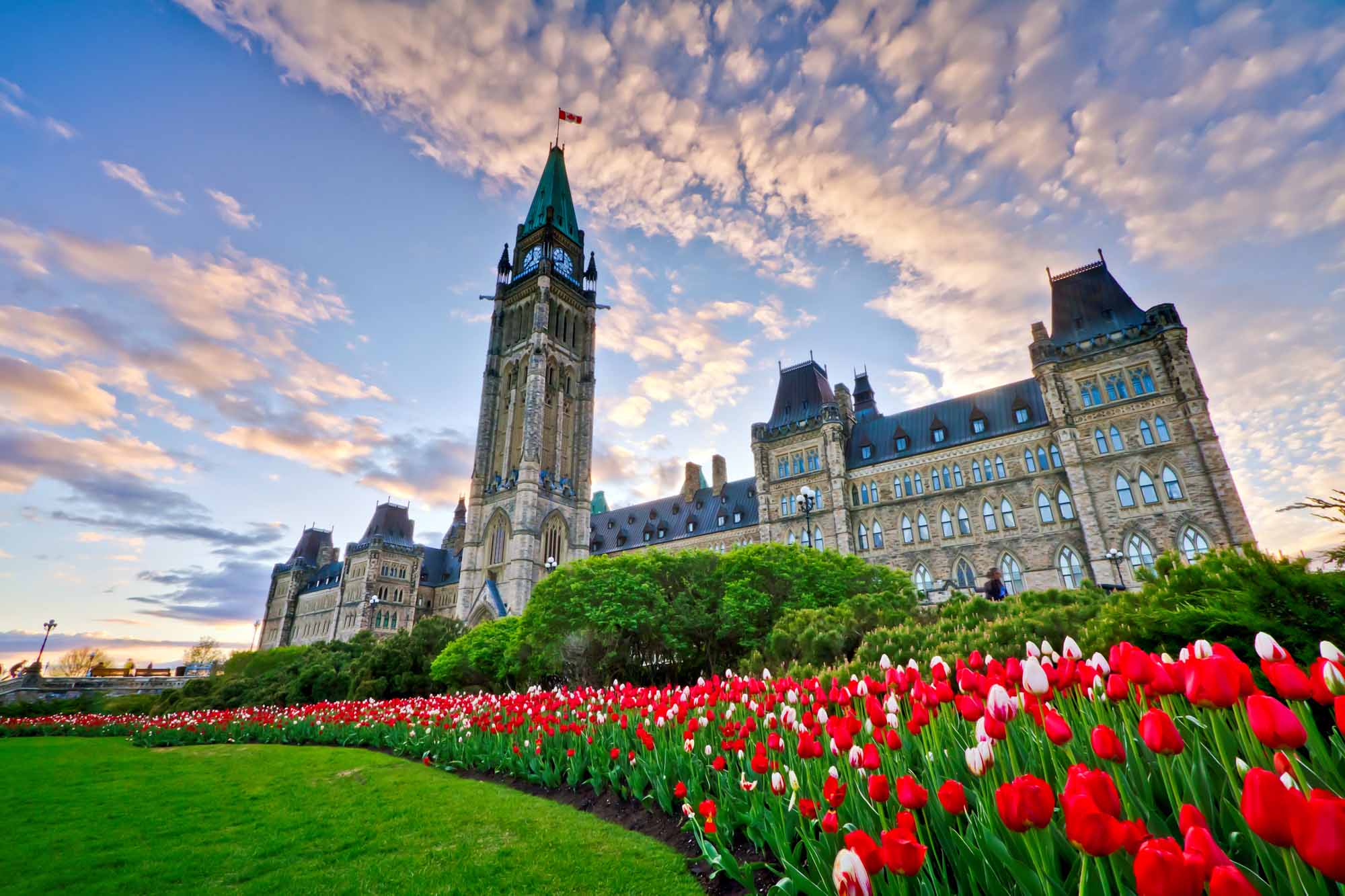
Canada is a federal state. It consists of 10 provinces – Alberta, British Columbia, Quebec, Manitoba, Nova Scotia, New Brunswick, Newfoundland and Labrador, Ontario (where the capital, Ottawa, is located), Prince Edward Island, Saskatchewan – and three territories – Nunavut, Northwest Territories, and Yukon. Each province or territory represents a separate mini-state that adheres to Canadian laws, while also having its own local laws that apply only within its territory and are enacted by local authorities. Each province has its own Premier, Parliament, and court, and each city within the province has its own police force. Canada also has the Royal Canadian Mounted Police, whose jurisdiction extends over all provinces.
The form of government is a constitutional monarchy. This means that the monarch, in this case, the Queen of Canada, Elizabeth II, does not make any government decisions and possesses only formal and executive authority. In Canada, the Queen is represented by the Governor General, who is currently Mary Simon.
In 1982, Canada became a fully independent state, and all constitutional jurisprudence is now based on the Constitution Act of 1867, the Constitution Act of 1982 along with the Canadian Charter of Rights and Freedoms and the "unwritten constitution," which consists of constitutional conventions.
The Parliament of Canada features the following parties: the Liberal Party of Canada, the New Democratic Party, the Conservative Party of Canada, the Green Party of Canada, and the Bloc Québécois. The Liberal Party is currently the ruling party in Canada, while the Conservative Party of Canada is the official opposition. The Prime Minister of the country is the head of the party that won the election.
Canada is a democratic state, with power divided into legislative, executive, and judicial branches.
The judicial branch deals with constitutional issues and their violations, with the Supreme Court resolving matters related to decisions made in lower court instances.
The legislative branch belongs to Parliament, which consists of two chambers: the House of Commons and the Senate. Legislative initiative belongs to both the Senate and the House of Commons (except for financial legislation). A bill is considered passed if it is approved by both chambers and confirmed by a proclamation from the Governor General. The legislative branch is key in Canadian politics.
The executive branch belongs to the Queen through the Governor General and is exercised by the Government – the Cabinet. In practice, the Government performs all functions of the Governor General. Currently, the Prime Minister of Canada and head of the executive branch is Justin Trudeau.
