


Free Healthcare
In Canada, healthcare for patients is free. This has its advantages (obviously), but it also comes with some disadvantages, such as long wait times.
At the same time, services from certain doctors still require payment. This includes dentists, psychologists, optometrists, the purchase of medications, etc. All of this is paid: either you pay out of pocket, or your insurance covers the expenses.
Since healthcare in Canada is regulated at the provincial level, there are some differences in the conditions for obtaining insurance and the list of expenses covered by it, depending on the specific province.
Registration with a Doctor
In Canada, you cannot see the required specialist or undergo any examinations right away. First, you need to make an appointment with a family doctor or visit what are called walk-in clinics – at these hospitals, doctors see patients without prior appointments. Only after this appointment will you receive a referral to the necessary specialist, for tests, and for additional examinations. By the way, tests are not ordered without necessity here.
Home Visits and Ambulance Services
You will not be able to call a doctor for a home visit here. You can call an ambulance, but this also incurs a fee. Moreover, in this case, you will receive a paramedic, who has a different level of medical education and different responsibilities.
The responsibilities of such a medical worker include rescuing and stabilizing the patient to transport them to the hospital, where they will be examined and given the appropriate treatment. This means that an ambulance service is true to its name – it is called for urgent cases. If you can get to the hospital on your own, that is what is recommended.
The provision of ambulance services is under municipal control, not provincial. This means that in each municipality, you will encounter different pricing for calls, as well as varying numbers of ambulance units.
Waiting in the Hospital
Patient admissions in Canada are based on the urgency of the situation. In other words, if, figuratively speaking, there is no axe sticking out of your chest, you will have to wait. There is logic in this because a person on the brink of death cannot wait, so even if you are in pain and discomfort, but your injury is not life-threatening, you will be attended to later.
As for waiting times for specific procedures and surgeries, a priority list was approved in 2004. In their case, the waiting time is closely monitored and controlled. However, each province tracks this process in its own way.
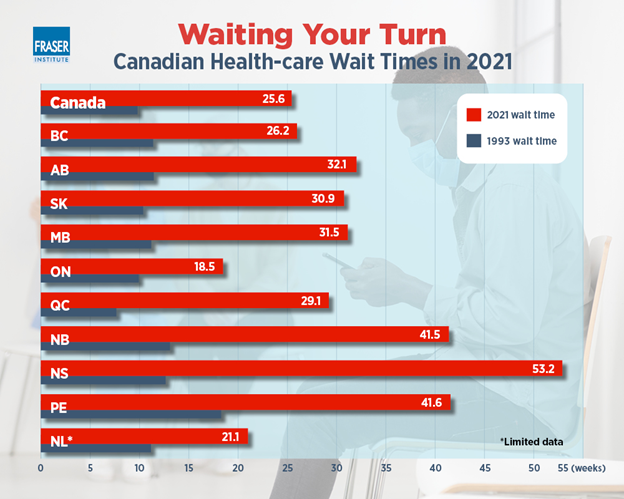
According to the Fraser Institute, in 2021, the average waiting period between the appointment with a general practitioner and receiving treatment reached 25.6 weeks. Of course, the figure will vary in each province. For example, Ontario reported the shortest waiting time, specifically 18.5 weeks. Nova Scotia showed the longest result – 53.2 weeks.
Prescribed Medications
If the medication you need is sold only by prescription, you will need to visit a doctor first to receive a diagnosis and have the corresponding medications prescribed. Only with such a prescription can you purchase medications at the pharmacy.
Specialized Hospitals
Canada does not have specialized hospitals. An infectious disease unit, a maternity ward, trauma care – all this will be found in one clinic. Although there are children's hospitals and oncology clinics.
Private Clinics
Private clinics are virtually absent in Canada. It is estimated that only about 1% of essential medical care in Canada is provided outside the public healthcare system.
In 1984, Canada passed the "Canada Health Act," which made it nearly impossible for private healthcare to function. The reason for this was a wave of additional bills faced by patients in the 1970s. Canadians had to deal with various user fees and co-payments that undermined the universality of Canadian healthcare.
Second Opinion
Hypothetically, you can seek a second opinion if, for example, you are unsure about the diagnosis made by your family doctor. However, in practice, it is not that simple, as much depends on the province, city, the availability of doctors’ schedules, personnel availability, and the urgency of your issue.
Systematic Medical Examinations
Every province sets its own list of necessary preventive medical examinations. You can also refer to the 2016 article by the College of Family Physicians of Canada, which discusses evidence-based systematic check-ups.
Patients should receive a letter from their family doctor or province reminding them of the impending deadline for their next examination.
Sick Leave
Since this issue falls under the labor code of the country, the answers to it also vary by province. However, at the federal level, there is no guaranteed paid sick leave in Canada. This means it all depends on your employer.
Canadians' Attitudes Towards the National Healthcare System

The attitude is quite mixed. On the one hand, for many, the free healthcare system in Canada is a source of pride (and sometimes even a target of jokes about our southern neighbors).
At the same time, there are signs of growing medical tourism from Canada. For instance, according to the Fraser Institute, in 2016, 63,459 Canadians traveled abroad for medical examinations.
Useful Links:
Caring for Kids New to Canada – this site provides information from specialists in pediatric health for immigrants about various available examinations, nutrition, and possible infectious diseases.
Choosing Wisely Canada – here, the Canadian pediatric community explains why it is important to reduce unnecessary tests and procedures.
About Kids Health – this site provides essential information about how a child's development should progress at each stage of growing up.
Learn about health care in Canada – find out everything you need to know about the healthcare system in Canada.
