


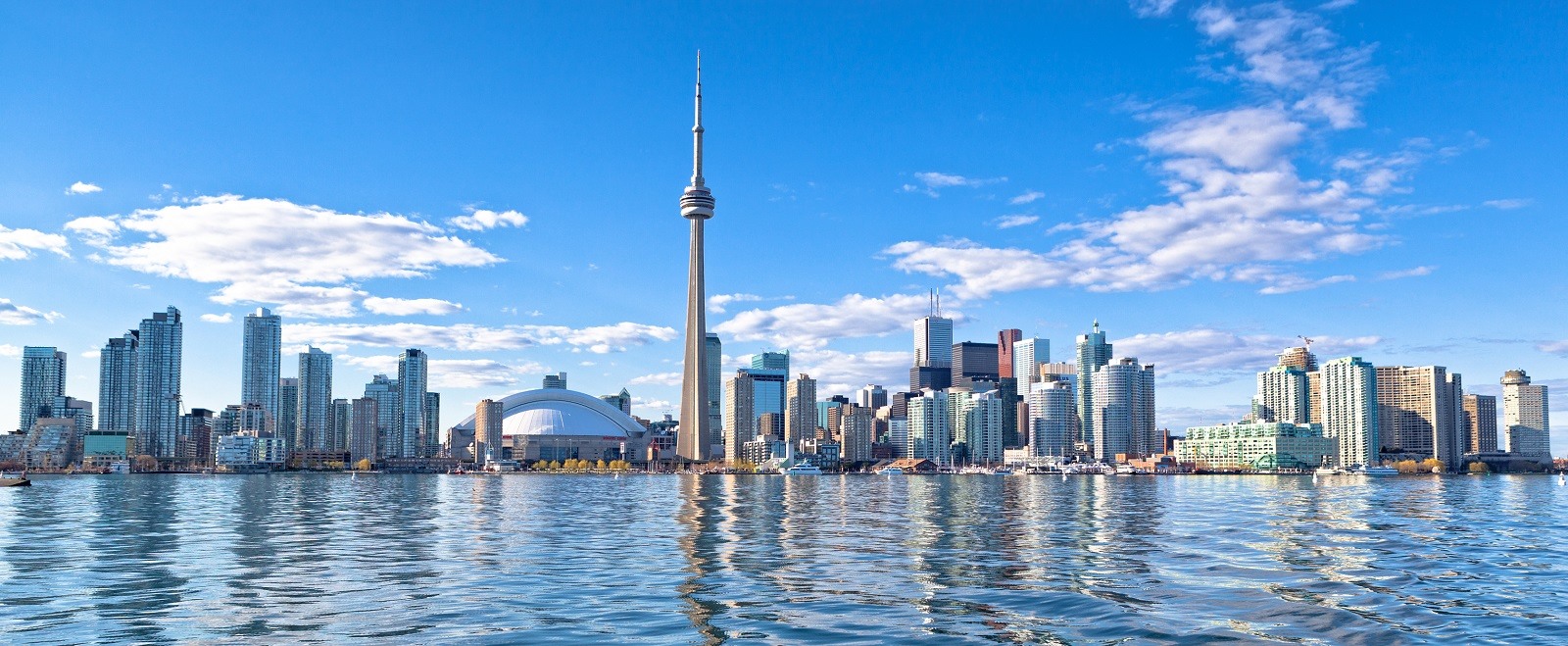
Although Toronto is not the capital of Canada, it is undoubtedly the most populous city in the country. Every year, thousands of people come here from other provinces of Canada as well as from different countries. The immense diversity of people has made Toronto a true cultural hub of all Canada, a multifaceted and dynamic city where everyone can find something interesting for themselves.
Geography
Toronto covers an area of 630 km² and ranks among the five largest cities in Canada. It is located on the shores of Lake Ontario, which is part of the Great Lakes. Several rivers flow through Toronto: the Rouge, Etobicoke Creek, Don, and Humber.
In the bay on the northern shore of Lake Ontario are 15 green islands that formed due to the erosion of the Scarborough Bluffs.
Today, three major islands have been identified within the group of Toronto Islands: Centre Island, Algonquin Island, and Ward's Island. These islands provide a piece of untouched wilderness within a large metropolis, and residents of Toronto come here to enjoy the peace and breathe the fresh air.
Since 1998, Toronto has been divided into six districts: East York, Etobicoke, North York, Scarborough, York, and Old Toronto. The current population density in Toronto is very high, at 8210 people/km².
Along with four regional municipalities—York Region, Halton Region, Peel Region, and Durham Region—Toronto forms the largest agglomeration in Canada, the Greater Toronto Area (GTA). According to the 2016 census, the GTA housed 6,417,516 people. The area of the agglomeration is 7124 km², with a population density of about 850 people/km².
In 2005, the Ontario government announced the borders of a greenbelt around the Greater Toronto Area, consisting of 7200 km², extending from Niagara Falls to Peterborough. The "greenbelt" plays an important ecological role and is essential for preserving the green spaces around the city and protecting them from development.
To learn more about Canada's geography, visit here.
Climate
Toronto is situated in the southern part of Canada, and the influence of Lake Ontario on the city's climate cannot be overlooked. Toronto lies in a humid continental climate zone characterized by warm, humid summers (average temperature around +22°C) and cold winters (the average winter temperature is -4 °C). Sharp temperature fluctuations are not uncommon here, and approximately 800 mm of precipitation falls annually.
To find out more about Canada's climate, visit here.
Population
According to available data, about 2.7 million people live in Toronto, while the Greater Toronto Area (GTA) has recorded 6.4 million residents. Thus, the GTA is the largest agglomeration in Canada and the seventh-largest agglomeration in all of North America.
Toronto is the economic and commercial center of Canada. Today, nearly one in five (18.1%) Canadians and almost half (44.4%) of all residents of Ontario live in Toronto or the GTA.
According to the UN, Toronto is the most multicultural city in the world. More than a hundred different languages and dialects are spoken here. This is primarily due to the fact that almost half of the city's population are immigrants from other countries: 9.6% of the total number of residents are immigrants from India (307,275 people), 8.2% from China (266,840 people), and 5.6% each from Italy and the Philippines (about 104,000 people). Additionally, Toronto is home to 300,000 Russian-speaking people who came from the CIS countries. Toronto also hosts Canada's largest Muslim community, numbering around 424,000 people.
A distinctive feature of Toronto is the active support for the uniqueness of different cultures and customs among immigrants. Unlike many other cities with large populations of immigrants, in Toronto, there is no imposed cultural assimilation of immigrants.
To learn more about Canada's population, visit here.
Culture and Recreation
Due to the large number of immigrants, Toronto boasts numerous ethnic cuisine restaurants and interesting shops. The city also hosts festivals and celebrations that reflect the cultural diversity of its residents, such as Caribana or the Toronto Chinese Lantern Festival.
In addition, Toronto is home to a plethora of attractions, known not only in Canada but also beyond its borders, including the CN Tower, the Royal Ontario Museum, Casa Loma, and the famous Toronto Zoo, which is among the top three largest zoos in the world.
Toronto is also a major international cultural center, where world-renowned artists perform and international awards are held. This is not surprising, as the city boasts a large number of theaters and concert halls: the Royal Alexandra Theatre, the Princess of Wales Theatre, and Massey Hall and Roy Thomson Hall.
Large concerts by popular artists occur not only in concert halls but also in sports arenas, such as the Scotiabank Arena and Rogers Centre.
In 2006, the Four Seasons Centre opened in Toronto—a opera theater that serves as the main stage for the Canadian Opera and the National Ballet of Canada.
Toronto also has a vast number of museums that cover various subjects: the Art Gallery of Ontario, the Hockey Hall of Fame, and the Canadian War Museum. If you're looking for something unusual, you can visit the Bata Shoe Museum or the Textile Museum of Canada.
Despite being Canada's largest metropolis, there are plenty of parks and green spaces, where city residents can escape the smog of the streets and persistent stress. At High Park, one can watch squirrels or have a picnic; at Berczy Park, you can admire a unique fountain; and by ferry, you can reach the islands in Toronto Harbour to enjoy tranquility and fresh air.
Economy
Toronto is among the top ten financial centers in the world, home to a significant number of banks and other organizations specializing in international financial operations. The Toronto Stock Exchange is the seventh-largest stock exchange in the world, and the five largest Canadian banks, collectively known as the "Big Five," have offices in Toronto.
The city is an important center for media, publishing, telecommunications, information technology, and film production, housing companies like Bell Media, Rogers Communications, and Torstar. The Greater Toronto Area also hosts major Canadian corporations such as Magna International, Celestica, Manulife, Sun Life Financial, and Hudson's Bay Company, along with prominent hotel companies like Four Seasons Hotels and Fairmont Hotels and Resorts.
History
For ten thousand years, the area now known as Toronto was inhabited by the Seneca, Iroquois, and Mississauga tribes. Interestingly, there is a version which suggests that the word "Toronto" comes from the Huron language, meaning "place of meeting."
The first European to arrive in this land in 1615 was French explorer Étienne Brûlé. However, the first European settlement was a French trading fort called Fort Toronto, which the French built near the mouth of the Humber River in 1750. After the Seven Years' War (1756–1763), according to the Treaty of Paris in 1763, several lands, including Canada, were ceded from France to Great Britain.
In 1787, the British crown purchased a piece of land of about one thousand square kilometers from the Mississauga tribe, residing at the site of modern Toronto, along the shores of Lake Ontario. By 1793, John Graves Simcoe founded the first permanent British garrison here, named Fort York. That same year, York was designated a town, and three years later, in 1796, it became the capital of Upper Canada.
The city continued to grow and expand, but during the Anglo-American War (1812–1815), American soldiers captured York and burned a large number of buildings. However, soon the Americans retreated. After the war ended in 1815, York grew rapidly, as many British immigrants arrived. Later in 1827, Royal College was established, becoming the first institution of higher education in Upper Canada. In 1849, Royal College was renamed the University of Toronto.
On March 6, 1834, when several neighboring settlements were annexed to Fort York, it was renamed Toronto. The first mayor of Toronto was William McKenzie, who organized the Upper Canada Rebellion in 1837.
In 1849, Toronto was struck by a severe fire, but it soon recovered, and by 1851 it was a thriving city with a population of 30,000. In 1867, Toronto became the capital of Ontario. The 19th century saw a significant increase in Toronto's population, as waves of immigrants poured into the city. By 1891, the population of Toronto had risen to over 180,000.
At the beginning of the 20th century, on April 19, 1904, another fire struck Toronto, but the city managed to recover quickly. During the economic crisis known as the Great Depression, Toronto suffered greatly; however, after World War II, a large number of immigrants from Europe and China came, resulting in the population exceeding 1 million by the mid-1950s.
As Montreal lost its economic influence, Toronto solidified its position. This was connected to the tensions among the French-speaking population, causing English-speaking residents to move to other cities, including Toronto. From this point on, Toronto began to develop rapidly, soon standing on the pedestal of the most influential cities in the world.
Another significant date in the city's history is January 1, 1998, when six separate communities—North York, Toronto, Etobicoke, York, East York, and Scarborough—were merged into a single municipality.
Today, Toronto is a thriving city, a major financial and cultural center. Approximately 3 million people live here, and each year a large number of immigrants from various corners of the globe arrive in the city.
To find out more about Canada's history, visit here.
}
